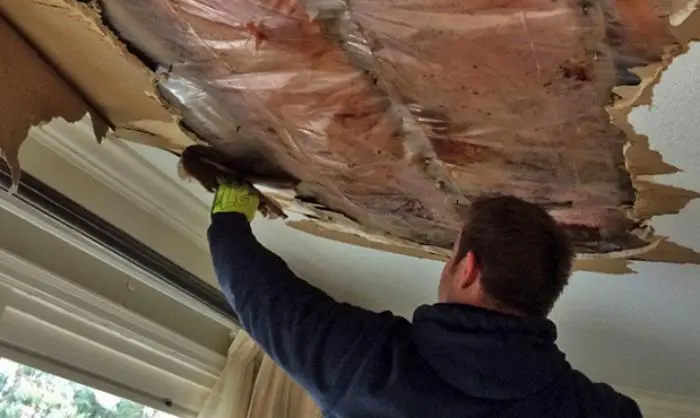
In a condo or apartment, a ceiling leak often starts in someone else's home. Carlsbad, California has thousands of homes in stacked buildings, so a stain on the ceiling can trace back to a washer, a tank or a toilet in the unit above.
Key takeaways
- A spreading brown ring points to a leak that has run a while, while active dripping means water is still arriving.
- A sagging or bulging ceiling is holding water and is best left to a crew to release in a controlled way.
- The first steps are to protect belongings, photograph the damage and tell the neighbor and the building manager right away.
- Water travels along joists and down wall cavities, so more than one unit can be affected.
- Drying in an occupied building is planned around neighbors, shared walls and access.
Why stacked homes leak into each other
Carlsbad has 10,817 homes in buildings of 5 or more units, including 2,778 in buildings of 50 or more, along with 7,272 single-unit attached homes. In those buildings one unit's floor is another unit's ceiling.
About 37 percent of Carlsbad's 44,038 occupied homes are rented, so a leak often involves a tenant, an owner and a building manager at the same time.
- A washer or dishwasher hose that fails in the unit above.
- A water heater in a closet that begins to leak.
- A toilet or bathtub overflow that runs through the floor.
- A supply pipe or drain inside the shared floor cavity.
Reading the stain on the ceiling
The shape and feel of a ceiling stain say a lot about what is happening above it.
What different stains suggest
A single dark ring that has grown over weeks suggests a slow leak. A fresh wet patch with drips means the source is active right now.
- Brown rings with a faint edge point to a slow, repeated leak.
- Dripping or a wet, glossy patch means water is still coming through.
- A bubbled paint surface means moisture has soaked into the drywall.
- Stains that spread along a wall suggest water running inside the cavity.
- A stain under a bathroom or kitchen above points to a fixture, appliance or drain.
- A stain that appears only after rain points toward the roof, not a neighbor.
A sagging or bulging ceiling
A ceiling that sags or bulges is holding water. It can drop without warning, so people should stay out from under it and keep pets away.
A crew releases the water in a controlled way, which protects the room below and the structure.
The first steps in the first hour
The goal is to limit what the water can reach while the source above is found and stopped.
- Move furniture, electronics and rugs out from under the wet area.
- Place a bucket or tub under any drip and cover belongings with plastic.
- Switch off power to ceiling lights and fans that are wet or near the stain.
- Photograph the ceiling, walls and floor, record a short video of any active drip, and write down the time.
- Tell the neighbor above and the building manager so the water can be shut off at the source.
Working with the neighbor and the building
Most of these leaks are accidents, and the fastest fix comes from a calm conversation. A knock on the door can find a failed hose quickly.
If no one answers, the building manager or association can shut off the water to the unit or the stack.
- Ask whether a washer, dishwasher, water heater or toilet was running.
- Share photos and the time the stain first appeared.
- Keep messages short and factual, preferably in writing.
- Ask that the unit above stop using the fixture until it is checked.
How water moves through a stacked building
Water does not stay in one spot. It runs along joists, drops through light fixtures and travels down wall cavities to the floor below.
A leak that begins in the unit above can touch the ceiling in one home, the wall in the next and the floor below that.
Hidden wet areas
Insulation and drywall hold water long after the surface looks dry. A moisture meter and thermal camera show where it traveled.
- Ceiling drywall and insulation above the stain.
- The top of the wall below the wet ceiling.
- The floor and baseboards where water ran down a wall.
- Cabinets and closets along the same wall.
Different buildings, different water paths
Carlsbad's housing mix goes well beyond big complexes. Besides the larger buildings, the city has 1,022 two-unit buildings, 2,177 homes in buildings of 3 or 4 units and 7,272 single-unit attached homes.
Small buildings and attached homes
In a duplex or a row of attached homes, the shared floor or party wall sits right between two households. A leak reaches the neighbor fast, and a quick conversation often settles the shutoff.
Buildings with many units
In a building with many units, water can cross several homes and shutoffs are often controlled by maintenance staff. Early notice to the manager matters more than anything else.
A ceiling leak repair and drying job in a large building usually starts with finding the stack where the water entered.
- Ask which valve serves the affected stack.
- Check the units on both sides and above and below the stain.
- Share photos and readings with the manager so every affected unit is on the same list.
What drying looks like in an occupied building
Ceiling leak water damage is handled differently in a stacked building than in a house, because neighbors share walls and access. The drying team plans equipment, cords and noise around everyone living there.
If the source was an appliance, appliance leak cleanup in the unit above is usually part of the plan too, so both homes dry together.
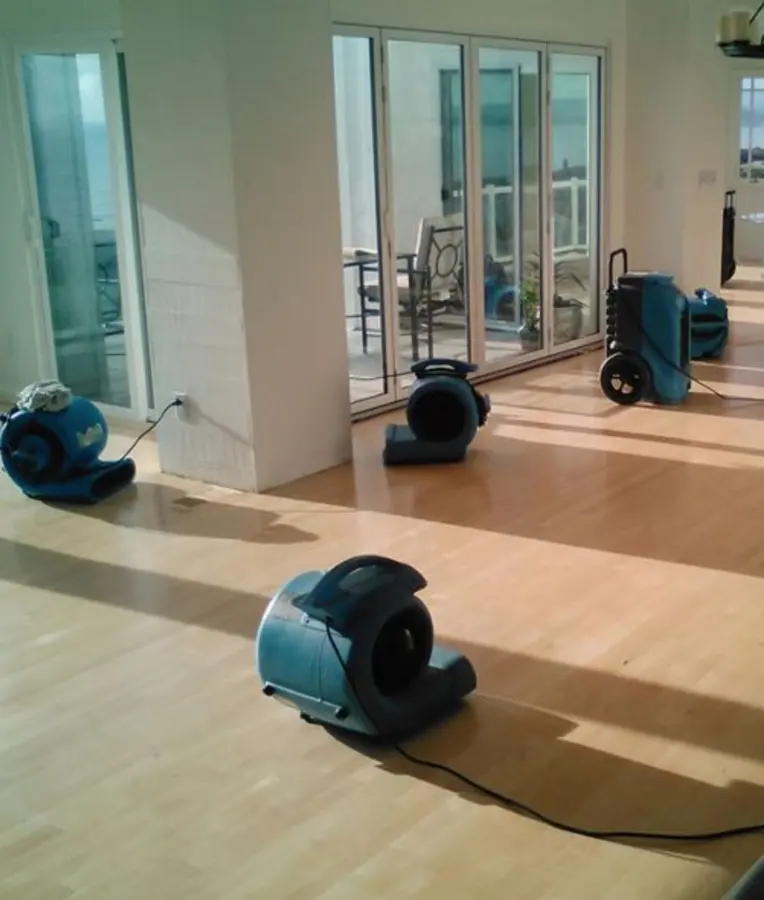
Once the water is out, structural drying sets air movers and dehumidifiers around the wet ceiling and wall. Readings are taken at each visit, and the equipment stays until the drywall and framing read normal.
- Extraction of standing water and soaked insulation.
- Removal of ceiling drywall only where it is saturated or sagging.
- Air movers and dehumidifiers placed to reach the wall and floor cavities.
- Moisture readings shared with the building manager.
Questions
How can a stain be traced to the unit above?
A moisture meter and thermal camera follow the wet area back along the ceiling and walls. The wet pattern usually points to a fixture or appliance directly above.
Is a bulging ceiling dangerous?
It can be. The ceiling is holding water and can drop without warning, so people should stay out from under it until a crew releases the water safely.
Who should be told first?
The neighbor above and the building manager or association, so the water can be shut off at the source while the cleanup is arranged.
Can the neighbor's unit be dried at the same time?
Yes, when access is agreed. Drying both homes together keeps water from lingering in shared walls and floors, and it avoids a second round of work later.
What if the unit is on the top floor?
Then the source may be the roof or a rooftop fixture rather than a neighbor. A stain that appears or grows after rain points that way, and the building manager should be told right away.
Does drywall always have to come out?
No. Drywall that is firm and reads dry can often stay. Sagging or saturated sections and wet insulation are removed.