Emergency Water Extraction in Vista, CA
Standing water and soaked carpet are pulled out with truck-mounted and portable extractors, then moisture is mapped so the drying equipment goes where the water actually traveled through the home.
(888) 450-9281Call about standing water now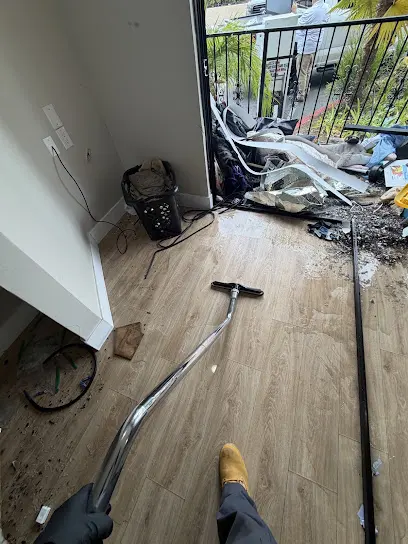
How emergency water extraction is handled in Vista, CA
- 01
Assess the water
The crew checks the water category, the affected area and the first moisture readings, then decides between truck-mounted and portable extraction.
- 02
Remove standing water
Pumps clear pooled water, then wands work across carpet in overlapping passes until the stream coming off the floor thins out.
- 03
Lift what cannot dry
Saturated pad, loose baseboards and soaked insulation are cut or lifted out, bagged and kept out of the drying zone.
- 04
Hand off to drying
Meters confirm what is still wet, and air movers and dehumidifiers are placed so the structure keeps drying after the pumps leave.
What does emergency water extraction cost in Vista, CA?
Emergency extraction usually runs from $400 for one room of clean water to $6,000 or more for deep water or a sewage loss, with several soaked rooms landing in the middle.
- Truck-mounted pass over the carpet
- Wet pad checked at the edges
- Hard floors squeegeed dry
- Heavy weighted extraction runs
- Ruined pad cut out and bagged
- Hard floors squeegeed off
- Submersible pumps for standing water
- Protective gear and containment
- Porous flooring removed
Biggest cost drivers: Water category, the number of rooms and how long the carpet stayed wet move a job between these tiers. For a closer planning number, run the water damage cost calculator. Every figure here is a typical range, not a quote.
First steps for emergency water extraction in Vista
- 1
Stop the source. Close the fixture valve or the main shutoff, and keep power off near wet outlets.
- 2
Lift small items. Move rugs, shoes and electronics to dry ground and prop up furniture legs on foil or blocks.
- 3
Photograph the water. Capture how high water reached on walls and the wet floor from a few angles before pumps start.
- 4
Describe the loss. Tell the crew what leaked, for how long and which rooms are wet.
Extraction decides how long drying takes, because every gallon left in carpet, pad or subfloor has to evaporate later. Water gathers fast in this area: a Buena Creek Road main break in 2014 left about a foot of standing water in a rented home.
What gets pulled out first
The crew starts with the most water and works toward the edges, keeping the wand moving so wet carpet gives up what it holds. Hard floors are squeegeed toward the extractor, and corners and thresholds get a second pass.
- Standing water on tile, wood and laminate
- Water held in carpet and cushion pad
- Pooled water at door thresholds and corners
- Moisture trapped under floating floors
Why early extraction matters
Wet drywall, carpet pad and framing can start growing mold within 24 to 48 hours, so removing the bulk of the water early protects materials that could otherwise be lost. Pad is usually the first thing to go, while carpet itself can often be saved when it is extracted promptly. A moisture meter check along baseboards and door frames follows the extraction, since water travels sideways through wall bottoms.
Clean, gray and black water
Category 1 water from a supply pipe is the easiest to save, Category 2 water from a washer or dishwasher carries soap and residue, and Category 3 water from a sewer backup or storm runoff needs protective gear, containment and removal of porous materials. The category is judged before the first pump starts.
When extraction alone is not enough
A quick pass over a thin film of clean water may be all a hard floor needs. Wet pad, hardwood, drywall bottoms and insulation hold water that extractors cannot reach, so those rooms move on to structural drying, and larger losses are tied to flood cleanup when storm water is involved.
Get the pumps running sooner
(888) 450-9281Vista water removal, day or nightRelated water damage services in Vista
Emergency Water Extraction across Vista
Extraction work covers every ZIP code in town, including 92081, 92083, 92084 and 92085, and neighborhoods such as Downtown Vista, Shadowridge, Buena Creek and Brengle Terrace, for houses, apartments, shops and offices alike on any day of the week.
The same service nearby: emergency water extraction in Encinitas, Oceanside, Carlsbad.
Emergency Water Extraction questions in Vista, CA
Short, specific answers about emergency water extraction for Vista homes and businesses.
(888) 450-9281Still wet in Vista? Call nowHow soon should extraction start?
As early as possible. Carpet pad and drywall begin to break down quickly once soaked, and the longer water sits the more material has to be cut out instead of dried.
Can wet carpet be saved?
Often, yes, when the water is clean and the carpet is extracted quickly. The pad underneath is usually replaced, and Category 3 water means carpet is removed regardless.
What equipment pulls the water out?
Truck-mounted units handle large areas, portable extractors reach upstairs rooms and tight spaces, and submersible pumps clear standing water that is deep enough to flow.
Is extraction the same as drying?
No. Extraction removes liquid water, while drying removes the moisture still held in wood, plaster and concrete. Most jobs need both, and the readings show when the second part is done.
Does insurance cover extraction after a storm?
It depends on the source. Water from a sudden internal failure is commonly covered, while rising flood water usually needs a separate flood policy, so the cause matters when filing.
What should be moved before the crew starts?
Small furniture, rugs, electronics and anything valuable on the floor. Leave wet drywall and flooring where they are so the damage can be photographed first.
Soaked floors need extraction before drying
Describe the room, the water source and how long it has sat, and the crew can load the right pumps, wands and dehumidifiers for the job.